The Geology of Dartmoor
Made predominantly of granite (65% of the total area), the landscape is characterised by its Carboniferous granite uplands and rocky tors. The granite was intruded into lower Carboniferous shales, cherts, limestones and shalesp during the late Carboniferous/early Permian Period - around 280 million years ago. This huge granite structure more correctly known as the Cornubian Batholith formed at depth and stretches as far west as the Isles of Scilly off West Cornwall.
As the granite cooled, hydrothermal activity on this metal rich 'soup' caused the mineralization of the surrounding rocks with lodes and veins of tin and copper ore forming in the fractured country rock. Other ores deposited and since commercially worked are arsenic, lead and iron ores. Other metals formed to a lesser extent including zinc, wolfram (tungsten), cobalt, bismuth, antimony, uranium and even gold. For further research have a look at The Geology of Devon by the University of Exeter Press.
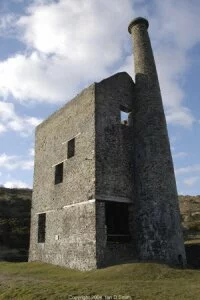
Image courtesy of Ian Smith at iandsmithphotography.com
Tavistock, the main town in the West Devon Mining District expanded largely due to the wealth generated by the extraction of, and trading in, copper and to a lesser extent tin. Indeed the largest mine in the southwest of England lay not in Cornwall but at Devon Great Consols near Tavistock.
The former sedimentary rocks lying closest to the intrusion were metamorphosed (altered by high temperature and pressure) into rocks such as greenstones, whilst the former surface of relatively soft sedimentary rocks were eroded over the years to form the now characteristic scenery. During the last Ice Age, some 11,000 years ago, the main body of ice stretched only as far south as the Bristol Channel. This means that although Dartmoor was covered in ice and snow, it was never actually glaciated. It therefore does not display the characteristic glacial features of U-shaped or hanging valleys, cirques or aretes. Instead Dartmoor's upland areas were subjected to repeated freezing and thawing during the glacial and interglacial periods. The rock weathered by the growth of ice crystals. This type of weathering shatters the bedrock into sharp angular fragments that accumulate on the hillsides as clitter slopes.
The Dartmoor Tors
In total, there are over 160 tors on Dartmoor. Here is a list of some of the main tors in order of height above sea level:
- High Willhays at SX 580892 - 621m (2,039ft)
- Yes Tor at SX 581901 - 619m (2,030ft)
- Great Links Tor at SX 551867 - 586m (1,924ft)
- Fur Tor at SX 588830 - 572m (1,876ft)
- Great Mis Tor at SX 562770 - 539m (1,768ft)
- Great Staple Tor at SX 542760 - 455m (1,493ft)
- Haytor, near Bovey Tracey at SX 757770 - 454m (1,490ft);
- Hound Tor at SX 743790 - 448m (1,469ft)
- Sharpitor at SX 559703 - 402m (1,320ft)
- Sheeps Tor at SX 565683 - 320m (1,050ft)
- Vixen Tor at SX 542742 - 320m (1,050ft) - now sadly inaccessible
Other notable tors include:
- Beardown Tor at SX 604778 with the ancient Beardown Man menhir nearby
- Black Tor at SX 573718 noted for its logan (or rocking) stone
- Brat Tor (otherwise known as Brai Tor) at SX 540855 with Widgery Cross on its summit
- The centrally placed Crockern Tor at SX 616758 - where the Dartmoor Stannary parliament met between 1494 and 1743
- The striking and much photographed Bowerman's Nose on Hayne Down about a mile from Hound Tor near Manaton at grid reference SX 742805. It stands about 6.6 metres high (21.5 feet) and is the hard granite core of a former tor
- Ger Tor at SX 547831 - notable for its spectacular views over the valley of the River Tavy
- Kes Tor near Chagford at SX 665862
- Leather Tor at SX 563700 has great views of Burrator Reservoir
- The easily accessible Mel Tor at SX 694725 - once again with some wonderful views
- The picturesque Yar Tor at SX 678739
- The unusual shaped Watern Tor at SX 629869.
Holiday Parks

Stay at a nearby Holiday Park and keep the kids amused all day! Parks in the vicinity include those at:

Hotels
Plenty of hotels are available locally. Consider those in the local towns:
Caravans
In the vicinity is a choice of camping and caravan sites offering high quality, affordable holiday accommodation. Consider camps in Dartmoor, Moretonhampstead, Tavistock and Newton Abbot.